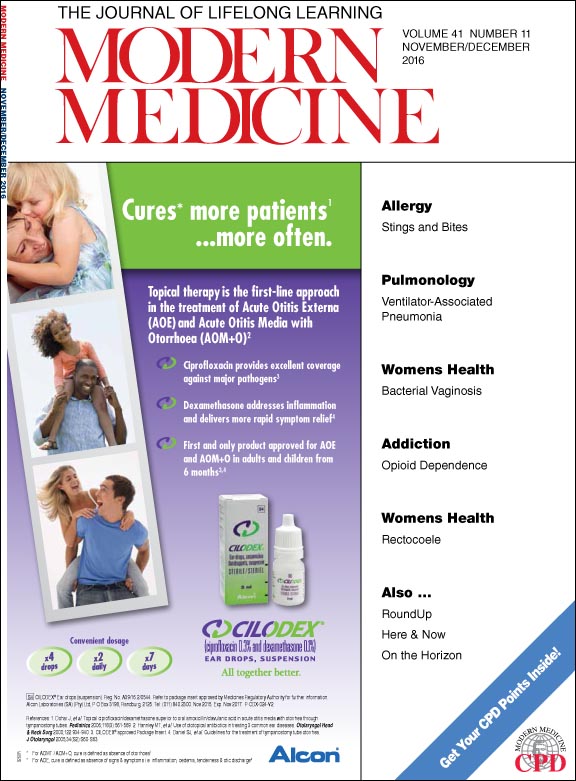

Identifying Ventilator-Associated Pneumonia Early is Key

Identifying Ventilator-Associated Pneumonia Early is Key – MM1611

When critically ill patients experience a life-threatening illness, they are also vulnerable to contracting ventilator-associated pneumonia, which increases morbidity and likely mortality as well as the cost of health care. Ventilator associated pneumonia is very difficult to diagnosis as there are no ‘golden rules’ for doctor’s to use as a diagnostic tool. Mortality is reduced with early diagnosis and treatment of VAP. Drug resistant VAP is becoming more prevalent.

Modern Medicine – November 2016

Beware of Allergic Reactions to Stings and Bites

Beware of Allergic Reactions to Stings and Bites – MM1611

Stings and bites from insects and ticks commonly cause allergic reactions, ranging from a local swelling to major anaphylaxis. Each patient responds in a unique way and the best course of action must be determined, taking several factors into account, including identification of the offending insect and the severity of the reaction.

Modern Medicine – November 2016

Concepts and misconceptions in oral anticoagulation

Concepts and misconceptions in oral anticoagulation – MM1611

While there is still a place for vitamin K antagonists (VKAs)/warfarin in anticoagulation therapy, the direct oral anticoagulants or DOACs (previously termed the new oral anticoagulants or NOACs) offer an advantage in every possible respect.
This was the take-home message in a series of talks given recently by Professor Jan Beyer-Westendorf, head of the Thrombosis Research Unit at the Centre for Vascular Medicine, University Hospital ‘Carl Gustav Carus’ in Dresden, Germany. as a guest of Bayer. He stated categorically that nowadays he only uses VKAs in selected patients when it’s unavoidable.

Modern Medicine – November 2016

October edition is online and ready to read

We welcome you to come and read through our latest, October, edition of Modern Medicine. It’s an ethics month, so we also include an interesting ethics-related article for you.

This edition includes a number of pieces on genetics and the use of pharmacogenomic testing. We also include a couple of great articles on Pneumonia, and Nutrition in Pregnancy, respectively.

We encourage all of our readers to complete the CPD questionnaire for this edition, this can be done on the answer-form included in the magazine, or on our website CPD system.

Modern Medicine, the journal that’s with you wherever you go.

The Role of Nutrition in Pregnancy

The Role of Nutrition in Pregnancy – MM1610

A woman’s suboptimal nutrition during pregnancy affects the development and health of her unborn child into adulthood. The process occurs via epigenetic changes that alter the ‘programming’ of developing organs and tissues. Suboptimal nutrition in utero can also result in these changes being transmitted to the woman’s grandchildren. Nutritional deficiencies can reduce a woman’s chance of conceiving and increase the likelihood of complications during pregnancy. The proportion of women with nutritional deficiencies is high. Nutritional testing and supplementation of women at risk is simple. Nutritional deficiency can also greatly increase the risk of cancer, mental illnesses and cardiovascular disease for the child in adulthood.

Modern Medicine – October 2016

Cognitive Tests Predict Antidepressant Response

Cognitive Tests Predict Antidepressant Response – MM1610

Major depressive disorder (MDD) is a prevalent and disabling condition with
a high frequency of non-recovery and recurrence, leading to substantial
mortality and morbidity. Only a subset of individuals with MDD (30-40%)
reaches symptomatic remission after adequate treatment with a first-line
antidepressant. Many do not reach premorbid levels of psychosocial functioning and a significant proportion present with residual symptoms.
More recent findings have raised hopes for identifying cognitive tests for predicting antidepressant clinical response, which would have the distinct advantage of being quick and easy to administer in a doctor’s office.

Modern Medicine – October 2016

Pneumonia: Who is at Risk?

Pneumonia: Who is at Risk? – MM1610

Risk factors for pneumonia include age, smoking and presence of chronic diseases, such as lung disease, heart disease and diabetes. Preventive measures include influenza and pneumococcal vaccination and smoking cessation. GPs are at the front line of management of patients with pneumonia, starting empirical outpatient antibiotic therapy and referring those who are very ill or at risk of deterioration to hospital. A chest x-ray is important for diagnosis of pneumonia. Most patients respond to empirical antibiotic therapy with amoxycillin, doxycycline or an appropriate macrolide antibiotic. Patients with nonresolving pneumonia require reassessment to confirm the diagnosis, identify the pathogen and look for complications or underlying disease such as malignancy.

Modern Medicine – October 2016

The Role of NSAIDs in Multimodal Analgesia for Post-operative Pain Relief

The Role of NSAIDs in Multimodal Analgesia for Post-operative Pain Relief – MM1610

Pain as defined by the International Association for the Study of Pain is an unpleasant sensory and emotional experience associated with actual or potential tissue damage. Early and effective relief from pain in the post operative period is of increasing importance in order to improve patient comfort and to restore a patient’s daily function as early as possible. Choice of analgesics in the post-operative period should be guided by an individual’s needs.

An important goal of postoperative pain relief is to provide subjective comfort,
inhibit trauma-induced afferent pain transmission and to blunt the autonomic
and somatic reflex responses to pain, leading to enhanced restoration of
function and enhancing recovery of the ability to breathe, cough and ambulate
without limitations.

NSAIDs are increasingly being combined with opioids to reduce the incidence of opioid related adverse effects.

Modern Medicine – October 2016

Using Genetic Information Improves Drug Therapy

Using Genetic Information Improves Drug Therapy – MM1610

Clinical pharmacogenomics, the use of genetic data to guide therapy decisions, can help determine whether individual differences in the expression of proteins or enzymes affect the metabolism of a particular drug. These effects can change the levels of active or inactive metabolites, which require the use of a different drug or altered dose for optimum efficacy.
Family doctors are usually the first resource for patient questions about genetics; but quick and accurate use of pharmacogenomic data in a clinical environment can be challenging. Patients have increasing interest in and access to their own genetic information, including pharmacogenomic data from direct-to-consumer genetic testing companies. Clinicians, however, are largely unfamiliar with principles supporting clinical use of this type of data and few primary care doctors are comfortable ordering a pharmacogenomic test or interpreting test results, often citing a general lack of education in this area.
When used appropriately, pharmacogenetic testing can be a practical tool to optimise drug therapy and avoid medication adverse effects.

Modern Medicine – October 2016

Verified by ExactMetrics