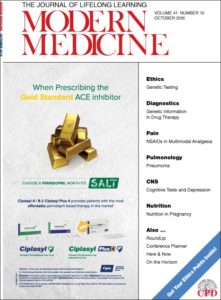

Ethics and Genetic Testing

Ethics and Genetic Testing – MM1610

The advent of the ‘genomic age’ through new DNA technologies has for many heralded the promise of a genetic revolution. In reality, although great strides have been made in diagnostic yields and personalised medicine, what has become evident are the limitations in our understanding. Existing challenges such as interpretation and uncertainty have increased and raised new ethical and moral questions for old problems.

Modern Medicine – October 2016

September Modern Medicine Digital Edition

The September edition of Modern Medicine is online and ready to read, albeit a little late (apologies for that).

We concentrate on Cardiology in this edition, with a pair of articles on heart failure and on stroke respectively. We also cover a number of more common ailments, including nausea, asthma and depression.

With spring upon us we also have a insightful article on Swimmer’s Ear, as well as a number of other interesting pieces.

For those of you looking for the references attached to the articles in the magazine, simply page to the end of the digital edition and you’ll find a comprehensive list.

We encourage all of our readers to complete the CPD questionnaire for this edition, this can be done on the answer-form included in the magazine, or on our website CPD system.

Modern Medicine, the journal that’s with you wherever you go.

Investigation of Nausea How Far to go Before Referral

Investigation of Nausea How Far to go Before Referral – MM1609

Nausea is a common clinical presentation. If the patient’s history and examination are normal then usually the diagnosis will be functional or idiopathic nausea. This is a diagnosis of exclusion and a few basic tests will often rule out serious pathology. Organic causes are usually apparent from a patient’s history and physical examination. A few basic investigations will rule in or out most underlying causes. Referral of patients to a gastroenterologist should be considered when the diagnosis is in doubt, there is the suspicion of an underlying gastrointestinal cause or to reassure the patient. Consider anxiety as an underlying or contributing factor to nausea.

Modern Medicine – September 2016

Emotional Blunting and Depression | Symptom or Side Effect?

Emotional Blunting and Depression | Symptom or Side Effect? – MM1609

When treating a patient for depression, doctors need to provide relief from the depressive symptoms, restore functioning, enhance quality of life and develop relapse prevention strategies. The main focus is on the reduction of depression symptoms. Emotional blunting, or the inability to experience usual emotions can be a side effect of many antidepressants. This emotional blunting can have a profound impact on the patient’s quality of life. It needs to be distinguished from residual depressive symptoms and if distressing the patient, may warrant a change of treatment.

Modern Medicine – September 2016

Asthma – COPD Overlap Syndrome | A merger of 2 distinct spectrums of inflammatory airway diseases

Asthma – COPD Overlap Syndrome | A merger of 2 distinct spectrums of inflammatory airway diseases – MM1609

Most practising doctors are familiar with the diseases of Asthma and Chronic Obstructive Pulmonary Disease (COPD). Within the cohort of these two disease entities, there are patients that do not completely satisfy the criteria to be diagnosed convincingly as either asthma or COPD. While the semantics of these diseases are far more important for research purposes than the diagnostic dilemma they pose, there have been several advances in both asthma and COPD that make the distinction or recognition of an asthma COPD Overlap Syndrome (ACOS) as a clinical entity more pertinent.

Modern Medicine – September 2016

Combatting Acute Otitis Externa – Swimmer’s Ear

Combatting Acute Otitis Externa – Swimmer’s Ear – MM1609

Acute otitis externa – swimmer’s ear – is an inflammation of the ear canal. It
can be caused by a variety of bacteria or fungi. Swimmer’s ear is treated with
over the counter ear drops and keeping the ears dry. When a person has had
an episode of acute otitis externa, the chances increase for them to get it again.

Modern Medicine – September 2016

Cardioembolic Stroke – A Clinical Approach

Cardioembolic Stroke – A Clinical Approach – MM1609

Stroke is a major cause of death, most commonly by infarct (in approximately 85% of cases). Cardioembolism accounts for 15-40% of all ischemic strokes and importantly, three year mortality from a cardioembolic stroke may be as high as 50%. The initial mortality may be related to the stroke but after six months the cause of death is often related to underlying cardiovascular disease. Identifying cardiembolic stroke is important and should be followed by a systematic workup to identify the source of cardioembolism, as it can prevent further events by treating the underlying cardiac abnormality.

Modern Medicine – September 2016

Treating Heart Failure With Reduced Ejection Fraction

Treating Heart Failure With Reduced Ejection Fraction – MM1609

Heart failure affects about two percent of the western population, with the prevalence increasing sharply from one percent in 40-year-old individuals to 10% above the age of 75 years. It is the most common cause of hospitalisation in patients over 65 years of age. Heart failure is defined as a syndrome characterised by an impaired ability of the heart to fill with and/or to eject blood commensurate with the metabolic needs of the body, resulting in a classic constellation of signs or symptoms of pulmonary and systemic venous congestion.

Modern Medicine – September 2016

Verified by ExactMetrics