


The Bidirectional Relationship Between Sleep and Pain

The Bidirectional Relationship Between Sleep and Pain – MM1701

Pain and sleep have a bidirectional relationship: pain disturbs sleep and disturbed sleep exacerbates pain. Treating sleep disorders has positive effects on pain symptoms, while treatment of pain with opioid analgesics can have positive and negative effects on sleep. Chronic opioid use is often associated with disordered breathing during sleep. Continuous positive airway pressure therapy may be indicated when disordered breathing during sleep is obstructive, whereas adaptive servo-ventilation therapy may have a role if central sleep apnoea is present. Some common mechanisms are involved, with central sensitisation known to have a role in both the pathogenesis of pain and disturbed sleep in patients with fibromyalgia.

Modern Medicine – January 2017

Improving Long-term Outcomes Following Acute Pulmonary Embolism

Improving Long-term Outcomes Following Acute Pulmonary Embolism – MM1701

Acute pulmonary embolism (PE) can result in complications many years after the initial event. An understanding of the long-term outcomes in patients following a PE is important to improve their management. Chronic thromboembolic pulmonary hypertension should be considered in patients with previous PE or VTE who present with ongoing or unexplained dyspnoea, exercise intolerance, atypical chest pain, syncope or peripheral oedema. There is increasing evidence of persistent functional and right ventricular impairment among long-term survivors of submassive PE. Patients who have had a PE have been found to have a threefold increase in 30-year mortality compared with controls, even after adjustment for comorbidities.

Modern Medicine – January 2017

Atrial Fibrillation: A New Perspective on an Old Problem

Atrial Fibrillation: A New Perspective on an Old Problem – MM1701

The three cornerstones of atrial fibrillation (AF) management have traditionally been anticoagulation, rate control and rhythm control. There is evidence that modification of the following main risk factors, obstructive sleep apnoea, obesity and exercise improves outcomes. Treatment of patients with sleep apnoea using continuous positive airway pressure reduces the risk and recurrence of AF. Patients undergoing cardioversion or AF ablation should be actively screened for sleep apnoea and treated if it is present. Light to moderate exercise is protective against AF. Risk factor management is essential in conjunction with antiarrhythmic medications and AF ablation to maximise treatment effects.

Modern Medicine – January 2017

Heart Failure, a Growing Yet Treatable Epidemic

Heart Failure, a Growing Yet Treatable Epidemic – MM1701

The clinical syndrome of heart failure (HF) is a final common pathway of most forms of cardiovascular disease. Affected patients typically experience poor quality of life, recurrent hospitalisations, and premature mortality. Although in general the prognosis of patients with HF is considered worse than that for patients with many cancers, the increasing use of effective selective therapies has led to considerable improvement in the prognosis.

Modern Medicine – January 2017

Study Reaffirms Low AF Stroke and Bleeding Rates

Study Reaffirms Low AF Stroke and Bleeding Rates – MM1701

Data from XAPASS – a prospective observational postauthorisation study, which enrolled more than 11 000 patients in Japan – confirmed low rates of both stroke and major bleeding in patients with non-valvular AF newly-initiated on rivaroxaban in routine clinical practice. These results were generally consistent with the Phase III J-ROCKET AF randomised clinical trial.

Modern Medicine – January 2017

2017 Medical Conference Planner

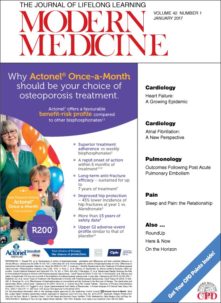
Modern Medicine is proud to present our 2017 Medical Conference Planner in line with our mission to add value for our readers.

The Planner is designed to be a one-stop tool for Doctors, and people in the healthcare industry, to use while they plan the events they’d like to attend in the coming year.

With an exhaustively researched list of almost 100 medical conferences that are due to take place over the coming year, the Planner is a tool you can’t afford to be without.

Modern Medicine magazine will include more information and updates on current events, on a monthly basis.

If you have any further events that you’d like to see included in future lists, please don’t hesitate to contact us with details.

November/December edition available now

We welcome you to come and read through our latest, November/December, edition of Modern Medicine. It’s an the last issue for the year so we also take this opportunity to wish all of our readers a merry and prosperous new year.

In the latest edition you’ll find CPD articles on Allergy, Opioid Dependence and Rectocoele.

We encourage all of our readers to complete the CPD questionnaire for this edition, this can be done on the answer-form included in the magazine, or on our website CPD system.

Modern Medicine, the journal that’s with you wherever you go.
Treatment of Patients with Opioid Dependence

Treatment of Patients with Opioid Dependence – MM1611

The prevalence of opioid dependence is growing with the increased use of pharmaceutical opioids. A number of effective interventions exist for patients with opioid dependence, including withdrawal services, opioid substitution treatment and psychosocial interventions, supported by self-help groups and harm-reduction services. Although historically most opioid-dependent users have used illicit opioids such as heroin as their primary drug, doctors are more often encountering patients who either misuse pharmaceutical opioid medications not prescribed for them or, alternatively, develop dependence on opioid medications used in the treatment of chronic pain.

Modern Medicine – November 2016

Bacterial Vaginosis, a Common Reason for Seeking Help

Bacterial Vaginosis, a Common Reason for Seeking Help – MM1611

Bacterial vaginosis (BV) is a condition characterised by the partial loss of the indigenous vaginal lactobacilli coupled with polymicrobial overgrowth of the vaginal epithelium. Although BV often remains asymptomatic, it is one of the most common causes of vaginitis, and hence among the most common reasons for women seeking medical help.

Modern Medicine – November 2016

Verified by ExactMetrics