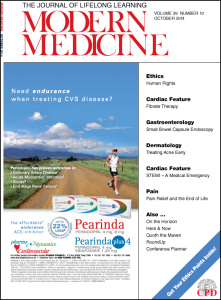


Treating Acne Early Reduces Scarring and Minimises Psychological Impact

Treating Acne Early Reduces Scarring and Minimises Psychological Impact – MM1410

Acne (acne vulgaris) is a common human skin disease, characterised by areas of skin with pimples, seborrhoea (scaly red skin), comedones (blackheads and whiteheads), papules (pinheads), nodules (large papules) and possible scarring.1 It affects skin with the densest population of sebaceous follicles. This includes areas of the face, upper part of the chest and back.

Modern Medicine – October 2014

Small Bowel Video Capsule Endoscopy

Small Bowel Video Capsule Endoscopy – MM1410

Video capsule endoscopy (VCE) is an important and useful tool in assessing the small intestine. Its main indication is in patients with recurrent and/or persistent bleeding in the small bowel for which no source has been found on gastroscopy and colonoscopy. VCE is the most sensitive and specific non-invasive test available for detecting mucosal changes in the small bowel.

Modern Medicine – October 2014

Fibrate Therapy for Dyslipidaemia and Prevention of Cardiovascular Disease

Fibrate Therapy for Dyslipidaemia and Prevention of Cardiovascular Disease – MM1410

The main use of fibrates is for the treatment of dyslipidaemia to lower plasma triglyceride levels and to raise HDL-cholesterol (HDL-C) levels. The effects of fibrates on LDL-cholesterol levels vary. Fibrates may be used either as monotherapy or in combination with statins. When combined with statins, fenofibrate is the preferred fibrate as it has a low risk of myopathy. The benefits of fibrate therapy in preventing ischaemic cardiovascular disease events appear to be confined to patients with baseline dyslipidaemia (raised triglyceride levels and/or low HDL-C levels).

Modern Medicine – October 2014

Human Rights

Human Rights – MM1410

It could be fairly stated that we live in an age of Human Rights or at least and more correctly, an age when much lip-service is paid to Rights, including Human Rights. The recent “umbrella revolution” in Hong Kong is driven by the demand for universal suffrage and the right to be governed by a democratically elected government.

Modern Medicine – October 2014

Modern Medicine – September 2014 Edition

The September 2014 edition of Modern Medicine is now available.

In it we feature a section on Allergies, we make available 3 more clinical CPD points for you to claim, and we showcase a number of new and interesting products from around the world.

Other features in this edition:
Critical Care |  Pain  |  Multiple Sclerosis  |  Dermatology  |  News

It’s fast and intuitive and it’s only a click away.

Impaired Immune Response Not Exacerbated by Hypothermia

Impaired Immune Response Not Exacerbated by Hypothermia – MM1409

Induced hypothermia is increasingly applied as a therapeutic intervention in ICUs. One of the underlying mechanisms of the beneficial effects of hypothermia is proposed to be reduction of the inflammatory response. However, a fear of reducing the inflammatory response is an increased infection risk. The Temperature Target Management (TTM) trial was conducted to study the effect of induced hypothermia on immune response after cardiac arrest.

Modern Medicine – September 2014

Is My Patient Suffering Complex Regional Pain Syndrome?

Is My Patient Suffering Complex Regional Pain Syndrome? – MM1409

Complex regional pain syndrome (CRPS) is a chronic pain condition mostly affecting one of the limbs (arms, legs, hands or feet), usually after an injury or trauma to that limb. CRPS is thought to be caused by damage to or malfunction of the peripheral and central nervous system. Although most cases of CRPS are triggered by an injury, the resulting pain is far more severe and long-lasting than normal.

Modern Medicine – September 2014

Epinephrine, First-line Treatment for High-risk Allergic Reactions

Epinephrine, First-line Treatment for High-risk Allergic Reactions – MM1409

Any allergic reaction, including the most extreme form, anaphylaxis, occurs when the body’s immune system reacts inappropriately in response to the presence of a substance that is wrongly perceived as a threat. Anaphylaxis is an acute, potentially life-threatening hypersensitivity reaction, involving the release of mediators from mast cells, basophils and recruited inflammatory cells. Anaphylaxis is defined according to a number of signs and symptoms occurring alone or in combination within minutes or up to a few hours after exposure to a provoking agent.

Modern Medicine – September 2014

Verified by ExactMetrics