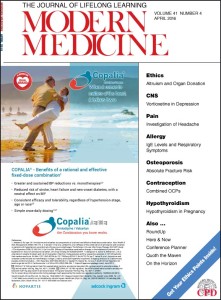
Vortioxetine A new option for depression

Vortioxetine A new option for depression – MM1604

Vortioxetine has been approved for treatment of adults with major depressive disorder. It adds to the repertoire of antidepressants available for individualising treatment and may have particular benefits for patients with cognitive impairment associated with depression.

In vitro studies indicate that it is an inhibitor of serotonin reuptake and acts as an agonist at the serotonin 5-HT1A receptor, partial agonist at the 5-HT1B receptor and antagonist at the 5-HT1D, 5-HT3 and 5-HT7 receptors.

In adults, the usual starting dose of vortioxetine is 10mg once daily, taken with or without food at any time of day.

Modern Medicine – April 2016

The Pursuit of Altruism Through Organ Donation

The Pursuit of Altruism Through Organ Donation – MM1604

“Effective altruism is about asking “How can I make the biggest difference?” using evidence and careful reasoning to find an answer. Doing “good” requires a scientific approach. Just as science consists of the honest and impartial attempt to work out what’s true, it requires a commitment to believe the truth whatever that turns out to be. As the phrase suggests, effective altruism consists of the honest and impartial attempt to work out what’s best for the world and a commitment to do what’s best, whatever that turns out to be.”
– William MacAskill, Doing Good Better: How Effective Altruism Can Help You Make a Difference

Modern Medicine – April 2016

Affordable Resolution of Colour vs Greyscale Monitor Complexities

Affordable Resolution of Colour vs Greyscale Monitor Complexities – MM1604

Bidvest Medical’s new Jusha-C61 dual greyscale/colour monitor with patented cutting-edge technology incorporates unique greyscale and colour autocalibration technology and a seamless dual vertical screen design that delivers the best visual perception to imaging diagnosis.

Modern Medicine – April 2016

March Edition of Modern Medicine Available

The Easter edition of Modern Medicine is available now. In it, we include a number of clinical articles, these focus on wound care, cardiology gastroenterology ad psychiatry, among other topics.

Local author, Dr Carol Hartmann, from the WITS faculty of health sciences writes an article on silver in wound care for us, and we include in-depth clinical articles on ulcerative colitis, heart failure and diabetes in patients with mental illness.

We’ve begun including all of our article references at the end of the digital edition, for those of you that like to see them.

Modern Medicine, the journal that’s with you wherever you go.

Managing Heart Failure – The key role of the GP

Managing Heart Failure – The key role of the GP – MM1603

HF is a complex syndrome whereby systemic perfusion is insufficient to
meet the body’s metabolic demands. Although its clinical features are quite
varied, it is frequently characterised by elevated left ventricular filling pressures, inadequate peripheral oxygen delivery and neurohormonal activation. In particular, activation of both the renin–angiotensin–aldosterone and sympathetic nervous systems leads to fluid retention and adverse pathological axis remodelling of the heart.

Management of most patients with heart failure occurs at an outpatient
level, with the GP playing a central role in initial diagnosis, counselling, regular
assessment of fluid status, titration and monitoring of medications and end-of life care.

Modern Medicine – March 2016

Ulcerative Colitis | Unravelling the uncertainty in diagnosis and management

Ulcerative Colitis | Unravelling the uncertainty in diagnosis and management – MM1603

Ulcerative colitis (UC) is a chronic inflammatory disorder of the colon characterised by a relapsing–remitting pattern in most patients. UC affects men and women equally, and the age at onset is between the ages of 15 and 30 years in most patients, with a smaller second peak in patients over 50 years. Although the cause of UC remains unknown, the pathogenesis is likely to be multifactorial with interplay between genetic, microbial and other environmental factors.

Prompt diagnosis of UC and timely management of flares are crucial to good patient outcomes. GPs play an important role in identifying new cases, the ongoing management of mild to moderately active UC and also in identifying and referring acutely unwell patients for specialty care.

Modern Medicine – March 2016

Judicious Use of Linezolid for Drug-resistant Bacteria

Judicious Use of Linezolid for Drug-resistant Bacteria – MM1603

While the choices available for the management of grampositive, drug-resistant bacterial infections are becoming limited, antimicrobial resistance is becoming increasingly problematic because of the widespread overuse of antibiotics.

Linezolid is a synthetic antibiotic belonging to a class of antimicrobials called the oxazolidinones. Linezolid disrupts bacterial growth by inhibiting the initiation process of protein synthesis—a mechanism of action that is unique to this class of drugs.

Modern Medicine – March 2016

Insight Linked to Meds Adherence in Schizophrenia

Insight Linked to Meds Adherence in Schizophrenia – MM1603

The first episode of a psychotic disorder typically occurs in late adolescence
or young adulthood, a critical time of development with respect to personality,
social role, education, and vocation. The first few years of psychosis appear to
be a critical period during which intervention needs to be initiated before the
consequences of psychosis become more severe. Early intervention is therefore
crucial in maximising outcomes.

Medication attitudes, insight and characteristics of support have been
identified as important determinants of adherence to medication,2 with poor
insight being linked to poor outcome of psychosis in multiple ways. The negative influence of poor insight has been demonstrated in relation to quality of life, rehospitalisation, poor treatment adherence and poor outcome of psychosis

Modern Medicine – March 2016

Diabetes and Mental Illness Challenges and practical progress

Diabetes and Mental Illness Challenges and practical progress – MM1603

Severe mental illnesses are associated with premature death and accelerated
cardiometabolic disease. Diabetes contributes substantially to the health burden in severe mental illness, with glycaemic, lipid and hypertension control often below the targets accepted as standard of care. Treatment disparities and unmet health needs are common and contribute to poorer health outcomes.

Screening for diabetes with measurement of fasting glucose levels and/or
HbA1c should be undertaken every six months in people with severe mental
illness. If weight gain occurs in this group, lifestyle strategies to prevent diabetes should be undertaken, with support and follow up.

People with severe mental illness and diabetes should be considered as a
‘special needs’ group, requiring longer, more frequent appointments with regula follow up. Assumptions should not be made about a patient’s healthy behaviour literacy, access to healthy food and food preparation facilities and knowledge and skill sets necessary to prepare healthy meals. People with severe mental illness and diabetes may require supported training in these areas.

Modern Medicine – March 2016

Verified by ExactMetrics