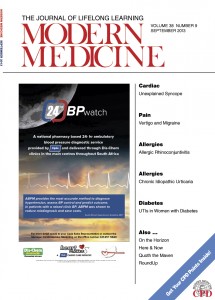

Unexplained Syncope: 30 Months to Diagnosis Patient Case Study

Unexplained Syncope: 30 Months to Diagnosis Patient Case Study – MM1309

This patient presented to a hospital emergency department following an episode of syncope in June 2009. He was at home, talking on the telephone, when the event occurred. He experienced no lightheadedness or incontinence and described the event as “like how you feel after an amusement park ride”.
Patient was admitted and hospitalised for two days.

Modern Medicine – September 2013

Ethical Aspects of Withdrawing or Withholding Treatment

Ethical Aspects of Withdrawing or Withholding Treatment – MM1308

Should health care practitioners (HCPs) preserve all lives, at all cost and for as long as possible? This view is attractive to many theologians and arm-chair philosophers who proclaim the sanctity of life. There is comfort and security for HCPs holding this view as it removes the responsibility for making some very difficult decisions and leaves all in the hands of a “Higher Being”. There is no need to consider others in the decision, costs or the quality of life under review.

Most bioethicists reject this absolutist premise. The duty of care is not an absolute duty to preserve life by all means. There is no obligation to provide life sustaining treatment if:
a) Its use is inconsistent with the aims and objectives of an appropriate treatment plan,
and
b) The benefits of that treatment no longer outweigh the burdens to the patient.

Modern Medicine – August 2013

Management of Cytomegalovirus and Herpes Zoster in Immunocompromised Patients

Management of Cytomegalovirus and Herpes Zoster in Immunocompromised Patients – MM1308

Cytomegalovirus (CMV) is a double-stranded DNA virus belonging to the Herpesviridae family. Other family members include herpes simplex virus type1 and herpes simplex virus type2, varicella zoster virus, human herpes virus HHV-6, HHV-7 and HHV-8. CMV shares many of the attributes of the other herpes viruses, including genome, virion structure, and the ability to cause latent and persistent infections. CMV has the largest genome of all herpes viruses. Multiple genetically distinct strains of CMV exist which may account for  the differences in virulence. Infection with more than one strain of CMV is possible.

Modern Medicine – August 2013

Glycaemic Control and Weight Loss in Type 2 Diabetes

Glycaemic Control and Weight Loss in Type 2 Diabetes – MM1308

Globally it was estimated in 2010 that there were 285m people living with type 2 diabetes, making up approximately 90% of diabetic cases. Traditionally considered a disease of adults, type 2 diabetes is increasingly diagnosed in children due to rising obesity rates. Type 2 diabetes is diagnosed as  frequently as type 1 diabetes in teenagers in the US. It is recognised as a global epidemic by the World Health Organization.

Modern Medicine – August 2013

Effective Treatment of Gram-positive and Gram-negative Bacterial Infections

Effective Treatment of Gram-positive and Gram-negative Bacterial Infections – MM1308

Even common problems in antibiotic treatment do not have simple solutions. Choosing one antibiotic drug from among several candidates entails balancing the benefits and the drawbacks associated with each. The physician must strike the right balance between effectively treating the current infection and maintaining options for future use in the light of growing drug- resistance. Here are three antibiotics to consider.

Modern Medicine – August 2013

Who Should Administer Conscious Sedation? Part Three: Sedation competence

Who Should Administer Conscious Sedation? Part Three: Sedation competence – MM1308

The previous article argued that competence to administer conscious sedation (CS) should move away from competence based on a practitioner’s specialty to competence based on skills and knowledge.

The UK’s General Dental Council says: “Dentists have a duty of care to administer conscious sedation only within the limits of their knowledge, training, skills and experience and healthcare professionals should have completed relevant postgraduate education and training and have clinical experience of the particular conscious sedation technique.” This principle is equally applicable outside dentistry, In fact, all international guidelines agree with the principles expressed above.

This article will outline the competence every sedation practitioner should have when he plans to administer CS.

Modern Medicine – August 2013

Verified by ExactMetrics