Common Cold

Common Cold

Among human diseases, the common cold stands apart. Not only is it one of the most common human diseases, but because there are so many respiratory viruses that cause colds, it is also one of the most complex. This review discusses the respiratory viruses and notes that all these viruses may cause the illness complex recognised as the common cold. The common cold is discussed as part of the “iceberg concept” of disease which ranges from asymptomatic infection to severe illness and death.

Modern Medicine – Issue 3, 2025

Integrated Care: A Strategy for Addressing Fragmented Healthcare

Integrated Care: A Strategy for Addressing Fragmented Healthcare

The fragmented nature of today’s health systems means that they are becoming increasingly unable to respond to the demands placed upon them. The focus on hospital-based, disease-based and self contained ‘silo’ curative care models undermines the ability of health systems to provide universal, equitable, high-quality and financially sustainable care.

Modern Medicine – Issue 3, 2025

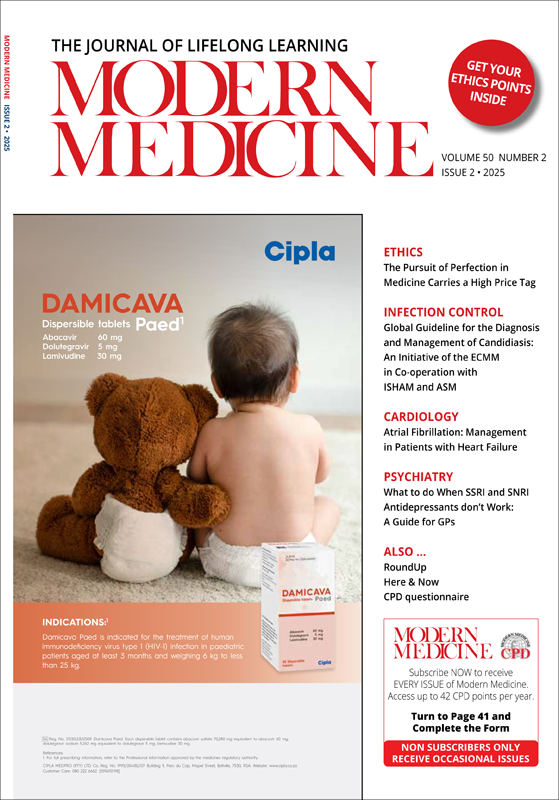
Issue2, 2025

Modern Medicine is now available for you to read. We have some great articles featured in this edition:

  • Ethics (CPD) – The Pursuit of Perfection in Medicine carries a High Price Tag
  • Infection Control (CPD)– Global guidelines for The Diagnosis & Management of Candidiasis
  • Cardiology (CPD)– Atrial Fibrillation: Management In Patients With Heart Failure
  • Psychiatry (CPD) – What To Do when SSRI and SNRI antidepressants don’t work: A GP’s Guide
  • A RoundUp Section & many more….

Also, a reminder that, not only do we have CPD questions available within the magazine itself, we also have an online CPD portal that allows you to score even more points by simply completing your test online.

What to do When SSRI and SNRI Antidepressants don’t Work: A Guide for GPs

What to do When SSRI and SNRI Antidepressants don’t Work: A Guide for GPs

Depression is the most common mental health related presentation in general practice, but only a third of patients achieve remission with first line selective serotonin reuptake inhibitors (SSRIs), and many experience significant adverse effects. When SSRIs and serotonin-noradrenaline reuptake inhibitors (SNRIs) fail or cause intolerable side effects, GPs can switch to other antidepressants within the same class or between different classes. GPs can also increase doses, combine medications or augment treatment with antipsychotics. Although all antidepressants are more effective than placebo, their efficacy and tolerability differ. Consider referring patients for specialist review if treatment failure persists despite trialling other options.

Modern Medicine – Issue 2, 2025

Atrial FibrillationManagement in Patients with Heart Failure

Atrial Fibrillation Management in Patients with Heart Failure

Atrial fibrillation (AF) often occurs in conjunction with heart failure and people with both conditions have increased mortality and morbidity. a combined focus on risk factor reduction and stroke prophylaxis is required, alongside a complex decision regarding suitability and preference for rhythm control over rate control. Most rhythm control medications should be used with caution in people with heart failure with reduced ejection fraction. Interventional approaches, involving complex ablation or cardiac resynchronisation therapy, have also started to change clinical decision-making for AF patients.

Modern Medicine – Issue 2, 2025

Global Guideline for the Diagnosis and Management of Candidiasis CPD: An Initiative of the ECMM in Co-operation with ISHAM and ASM

Global Guideline for the Diagnosis and Management of Candidiasis CPD: An Initiative of the ECMM in Co-operation with ISHAM and ASM

Candida species are the predominant cause of fungal infections in patients treated in hospital, contributing substantially to morbidity and mortality. Candidemia and other forms of invasive candidiasis primarily affect patients who are immunocompromised or critically ill. In contrast, mucocutaneous forms of candidiasis, such as oral thrush and vulvovaginal candidiasis, can occur in otherwise healthy individuals. Although mucocutaneous candidiasis is generally not life-threatening, it can cause considerable discomfort, recurrent infections, and complications, particularly in patients with underlying conditions such as diabetes or in those taking immunosuppressive therapies. The rise of difficult-to treat Candida infections is driven by new host factors and antifungal resistance. Pathogens, such as Candida auris (Candidozyma auris) and fluconazole-resistant Candida parapsilosis, pose serious global health risks. Recent taxonomic revisions have reclassified several Candida spp, potentially causing confusion in clinical practice. Current management guidelines are limited in scope, with poor coverage of emerging pathogens and new treatment options. In this Review, we provide updated recommendations for managing Candida infections, with detailed evidence summaries available in the appendix. This is a shortened version of the original article. For additional information, see the Appendix online.

Modern Medicine – Issue 2, 2025

The Pursuit of Perfection in Medicine Carries a High Price Tag

The Pursuit of Perfection in Medicine Carries a High Price Tag

The nature of healthcare, where patient lives and outcomes are directly impacted by a medical professional’s actions, inherently demands a high level of precision and excellence. This environment can cultivate a mind-set in which anything less than perfection might be seen as a failure with severe consequences, amplifying the pressure to achieve and maintain extremely high standards. This quest for excellence can exact a heavy toll on doctor health and well-being.

Modern Medicine – Issue 2, 2025

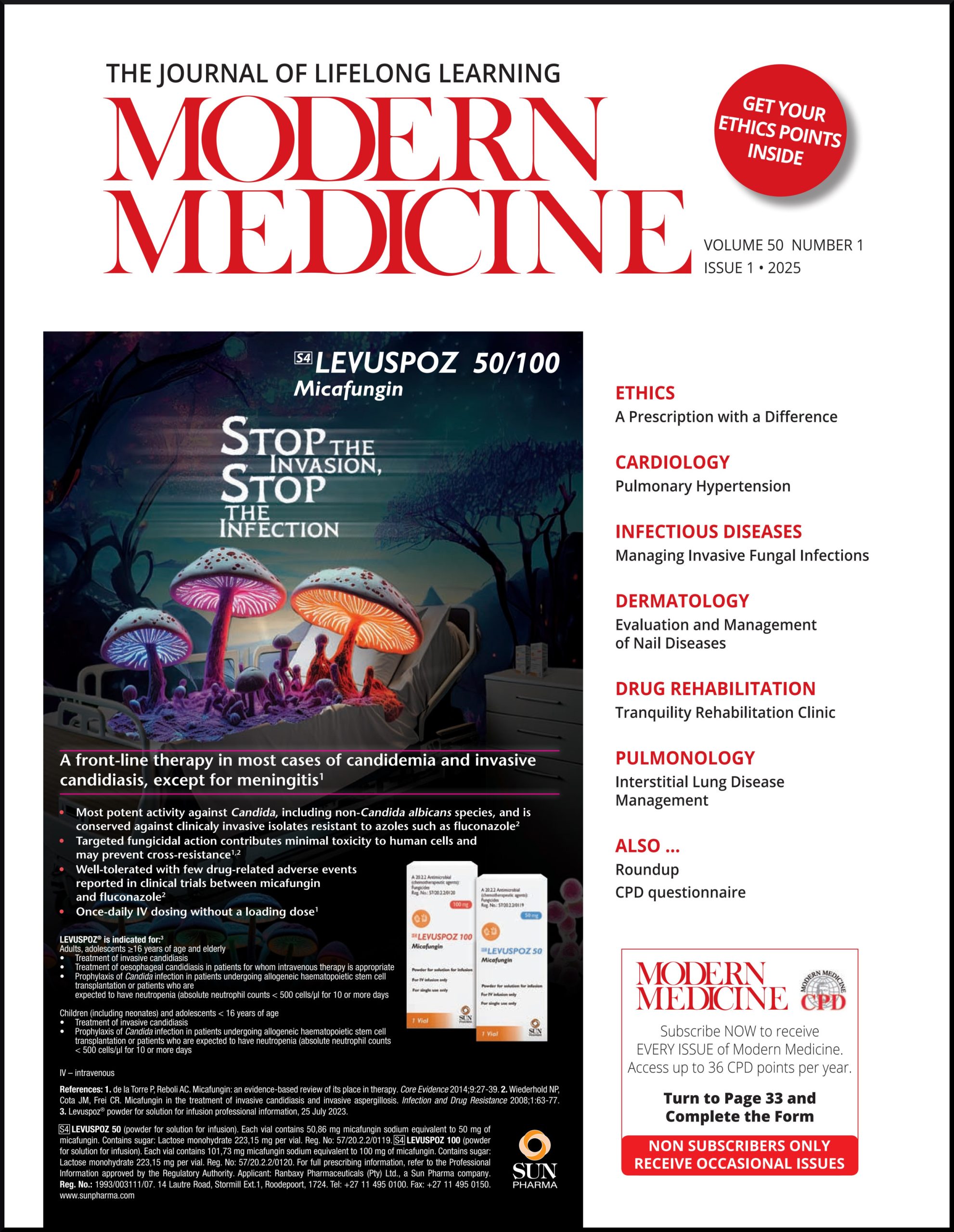
Issue 1, 2025

The latest edition of Modern Medicine is now available for you to read. We have some great articles featured in this edition:

  • Ethics (CPD) – A prescription with a difference: Gratitude
  • Infectious Diseases – Managing Invasive Fungal Infections in the Immunocompromised patients
  • Dermatology (CPD)– Evaluation & Management of Nail Diseases
  • Cardillo (CPD) – Pulmonary Hypertension: What’s New in diagnosis & Treatment
  • A RoundUp Section & many more….

Also, a reminder that, not only do we have CPD questions available within the magazine itself, we also have an online CPD portal that allows you to score even more points by simply completing your test online.

Interstitial Lung Disease: From Initial Investigations to Treatments, Shared Care and Beyond

Interstitial Lung Disease: From Initial Investigations to Treatments, Shared Care and Beyond

Interstitial lung disease (ILD) is characterised by progressive scarring of the lungs, leading to respiratory failure and a high symptom burden. High resolution CT of the chest with prone views is the investigation of choice when assessing for ILD. A low threshold should be applied for investigating patients presenting with persistent cough or dyspnoea with risk factors for ILD including connective tissue disease, occupational exposure, certain drug therapies and a family history. Antifibrotic therapy (nintedanib) for any patients with ILD who exhibit progressive fibrosing features offers an opportunity for improved patient outcomes with early disease identification and access to respiratory services. Blood monitoring is required lifelong for patients taking antifibrotics or steroid-sparing ILD treatments.

Modern Medicine – Issue 1, 2025

Verified by ExactMetrics