
Schizophrenia The GP’s crucial management role

Schizophrenia The GP’s crucial management role

Early recognition and referral are key in managing schizophrenia and related psychoses. Management should occur within a framework of autonomy and self-determination and, where possible, with family or carer inclusion. Pharmacological and psychosocial treatments improve outcomes, including quality of life, for people affected by schizophrenia. Antipsychotic, mood stabiliser and antidepressant medications may all be indicated in treating psychoses.

Modern Medicine – Issue 3 2020

Help Children to Stop Wetting Their Beds

Help Children to Stop Wetting Their Beds

Parents often worry about bed-wetting in their children, a problem defined as “involuntary urination in children five years of age or older.” In reality, approximately 15% of children in the US are still wetting the bed at age five. Most parents want practical, real-world assistance to help them deal with the issue of bedwetting.

Modern Medicine – Issue 3 2020

Anti-VEGF Agent Use in Diabetic Macular Oedema

Anti-VEGF Agent Use in Diabetic Macular Oedema

Diabetic macular oedema (DMO) is the most common cause of vision loss in patients with diabetic retinopathy, with an increasing prevalence tied to the global epidemic of type 2 diabetes mellitus. As a consequence of recent rigorous clinical trials, laser photocoagulation is no longer recommended for the treatment of DMO and anti-vascular endothelial growth factor therapy (anti-VEGF) has emerged as first-line therapy.

Modern Medicine – Issue 3 2020

Dispelling Myths and Misconceptions About Intrauterine Contraception

Dispelling Myths and Misconceptions: About Intrauterine Contraception

Intrauterine contraception is highly effective and is associated with low rates of unintended pregnancy. However, this form of contraception is not widely used, despite being recommended in clinical guidelines. Despite the evidence about intrauterine contraception (IUD) effectiveness and safety, myths and misconceptions about the methods persist.

Modern Medicine – Issue 3 2020

Moral Injury is at the Root of Burnout

Moral Injury is at the Root of Burnout

Each day healthcare providers are presented
with new situations from their patients and clients. Many of these situations require much contemplation, and often both personal and professional judgment is used to come to a conclusion.
In many cases, the decision-making process becomes difficult due to personal and professional beliefs, as well as institutional
and legal requirements placed upon the healthcare provider. This phenomenon, known as moral distress, is “when one knows the right thing to do, but institutional or health system constraints make it nearly impossible to pursue the right course of action”.

Modern Medicine – Issue 3 2020

Issue 2 2020

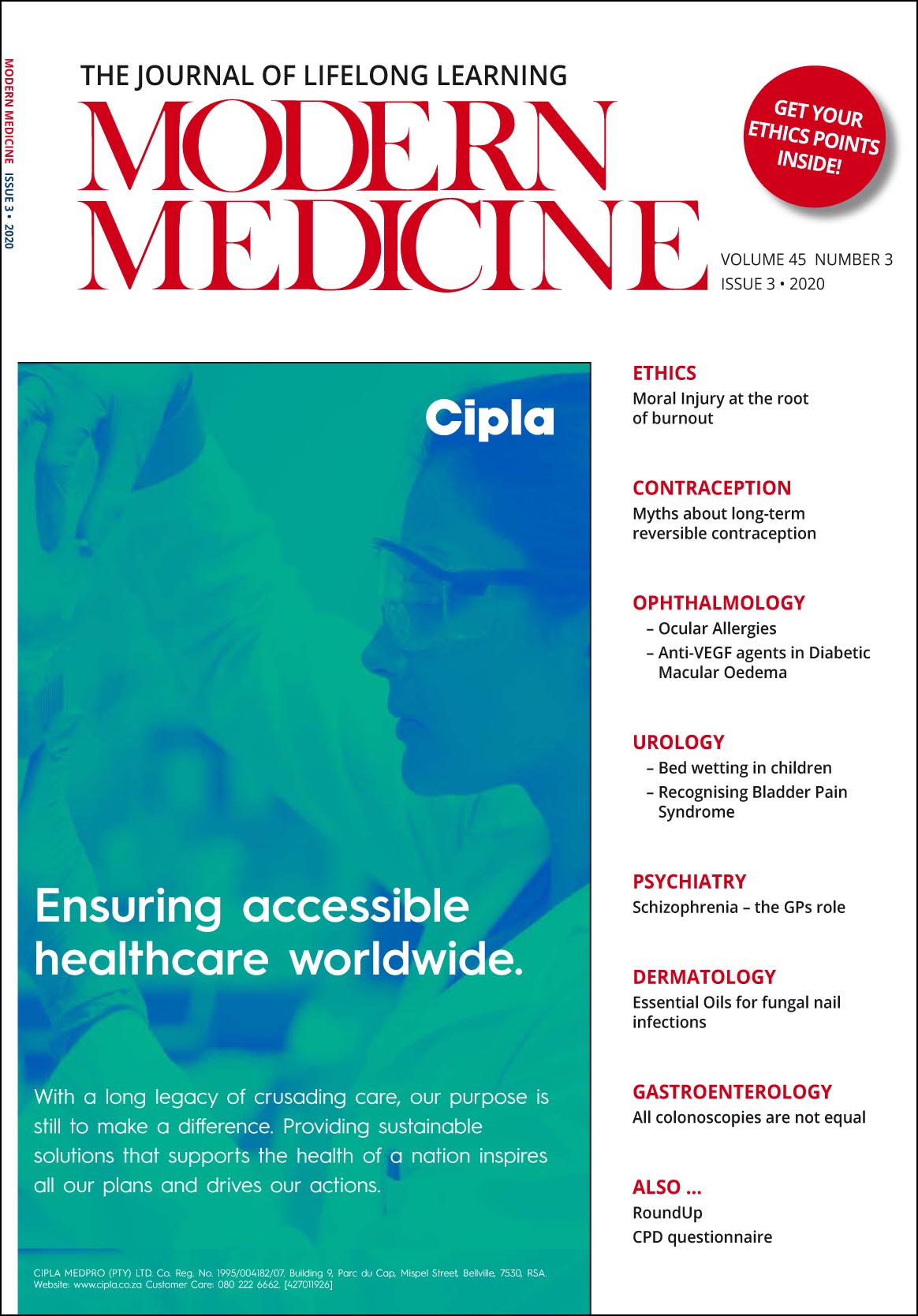
Issue 2 of Modern Medicine for 2020 is here. This edition of the magazine includes articles on Cardiology, Ethics, Infectious Diseases, and a Corona Virus breakdown to name a few. Have a look through and I’m sure you’ll find something to your liking to read in it.

Also, a reminder that, not only do we have CPD questions available within the magazine itself, we also have an online CPD portal that allows you to score even more points by simply completing your test online

Modern Medicine, the journal that’s with you wherever you go.

Venous Thromboembolism Applying new guidelines in primary care

Venous Thromboembolism Applying new guidelines in primary care

Venous thromboembolism (VTE) is a potentially life-threatening diagnosis commonly encountered in the primary care setting. Primary care doctors play an important role in timely diagnosis and evidence-based treatment decisions. The Thrombosis and Haemostasis Society of Australia and New Zealand guidelines on management of venous thromboembolism (VTE) provide succinct, evidence-based guidance on diagnosing and managing deep vein thrombosis and pulmonary embolism. The diagnosis of VTE rests on radiological findings. Duration of anticoagulation is determined by risk of progression and recurrence and must be weighed against bleeding risk.

Modern Medicine – Issue 2 2020

Choose the Right Topical Carrier For Inflammatory and Allergic Skin Disorders

Choose the Right Topical Carrier For Inflammatory and Allergic Skin Disorders

Topical corticosteroids play a major role in the treatment of many dermatologic conditions. However, successful administration depends upon obtaining an accurate diagnosis, choosing the correct drug, selecting the appropriate vehicle and potency, and the frequency of application.

Modern Medicine – Issue 2 2020

Cut the Itch in Childhood Atopic Dermatitis

Cut the Itch in Childhood Atopic Dermatitis

Atopic dermatitis is a chronic multifactorial disorder that requires multidisciplinary management. The recent literature confirms that the treatment of itching is a challenge. Children with chronic atopic dermatitis-related itch require a comprehensive treatment approach that addresses the underlying cause of pruritus, as well as symptoms and complications that extend beyond the physical domain.

Modern Medicine – Issue 2 2020

Verified by ExactMetrics